Monday

Member Spotlight--Lori


Member Spotlight: Lori

Lori moved to Louisville four years ago from Phoenix, which has a vote by mail system. Being accustomed to easy voting and high voter turnout, she was surprised at how voting works in Kentucky. After the 2016 election, she decided to do something about the low voter turnout in this state.

Lori started a MeetUp.com group called Liberals Over 50, and also checked out other local and national groups. She discovered Together We Will: Louisville through our Voter Registration Training. Along with some other members of her MeetUp Group, Lori attended our training and joined our Voter Registration Working Group. Soon she stepped up to help organize volunteer opportunities for the group, and also went out registering voters every weekend this spring. She recently became Outreach Coordinator for the Louisville Democratic Party and will be organizing their voter registration efforts. As an introvert, she has had to go outside of her comfort zone for her activism, but as a result, she says, “I’ve come out of my shell”.

Lori also volunteers for a state House candidate, managing the candidate's Twitter account. “Twitter is my outlet,” she said. She handles all of her activism and a full time paralegal job by taking time off from social media occasionally, and going to the movies or the pool when she gets too stressed out. She’s in this for the long term because, “after the November election, it’s Bevin’s and then Trump’s.”

Her advice for new activists is “Be patient, be persistent. We’re all learning.” Also, it’s important to “take initiative—no one else is going to do it, you have to do it!” 

Saturday

Immigrant children separated from their parents - "Missing children" What's really going on?


There are many articles and much misinformation circulating about the children and families being detained at the border by ICE. Let’s take a minute and discuss the facts and find out how you can help.

Here's what we know.

Children are being separated from their parents.

Early in April, Attorney General Jeff Sessions began a “zero tolerance” policy aimed at migrants crossing the border illegally and called for every undocumented immigrant to be charged with a crime. When undocumented immigrants are caught crossing the border, they are taken to a federal court, and then on to detention centers to await trial. Their children are taken from them and put into the custody of the Health and Human Services Office of Refugee Resettlement (HHS/ORR).

A Customs and Border Protection official told lawmakers last week that 658 children had been separated from their parents at the border from May 6 to May 19, 2018 as the parents face charges. That’s in addition to hundreds more who were estimated to have been removed from their parents since October.

Parents will face trial and, if found guilty, could spend six months to two years in prison until they are deported. What is unclear is if these children will be reunited with their parents prior to deportation or if they remain with their sponsors until they are possibly deported.

Unaccompanied minors and minors taken away from their parents have no right to an attorney in the U.S. if they are undocumented. That means that a four-year-old would have to make their own case for asylum. Because of this new policy, we are ruining any chances these children may have to seek asylum in this country. That's probably what the Trump administration wants, but it’s not right and all asylum seekers need a fair chance at being heard in court. One Woman's story - her sons are 4 and 10 years-old.

Children lost by the Department of Health and Human Services

There are reports that the federal government has lost 1,500 children. This has understandably sparked quite a bit of outrage. What we now know is that these children are not all “lost." The Department of Health and Human Services began making calls to locate over 7,000 migrant children from October to December of 2017. Of those children, over 6,000 were still with their sponsors, some had run away, and some had relocated to live with a non-sponsor. There were 1,475 cases where HHS made just one phone call, and the sponsors did not answer.  These children were not followed up on, and many of these sponsors and children do not want to be found because of deportation concerns.  


What you can do:

Reach out to your elected officials. Let them know that this is an important issue to you and children should not be separated from their families. Fleeing violence, drug cartels and gangs in their native country should not be a crime. Democrats and Republicans alike are coming out against this new policy. “It’s never a good idea to separate small children from their parents,” Rep. Carlos Curbelo (R-FL) said earlier this week. “I cannot defend that, nor do I wish to.”

Simply say, “I am outraged by how our government is treating children at the border. What is my Senator/Rep doing about this?” 


  • Support local immigration and charity services that help support migrants and their families. A list of local services are on this link: Kentucky Immigrants and Refugees 

  • Vote! Every single vote counts. Start with your local representatives. Research and learn their stance on immigration policies and read their statements regarding the current immigration crisis. Let’s start electing candidates who have a heart and compassion. The way we can make a difference on the federal level is to start locally.
  • Speak out. Use your voice on your social media. Share *reliable* articles that are offering the facts (TWW has a great blog post on how to weed out the fake articles from the real ones - HERE). If you like to write, write letters and postcards to your representatives, either opposing their views and votes regarding immigration or write and show your support to candidates who share your views. Find a local postcard party group and join in. Meet great like-minded people, have some fun and write for change.
  • Keep an eye out for any local activity, such as marches or rallies regarding immigration. Make signs and show up. Voices carry in large crowds and the more people that show up in support of the children, the more changes are likely to be made. Attend events that support the integration of immigrants into the community such as this upcoming event: Global-Local Summit: A Community Discussion on Integration


The Office of the United Nations High Commissioner for Human Rights has recommended guidelines for human rights at international borders which you can read here. The reported actions our DHS is taking do not comply with these guidelines. You can contact the UN Office for Human Rights here


The ACLU is gathering signatures to petition Kevin K. McAleenan, Commissioner of United States Customs and Border Protection to stop the government from abusing immigrant children. You can find the petition here.

Amnesty International has been calling for an end to the U.S. policy of separating children at the border. Their call to action can be found at the end of this post here


Friday

Kentucky Immigrants and Refugees - local background

Give me your tired, your poor, your huddled masses yearning to breathe free.
– Emma Lazarus, As seen on the Statue of Liberty


Immigrants and refugees are our neighbors, friends, teachers and co-workers. 


Refugees come from Cuba, Congo, Somalia, Iraq, Syria and more
72% were resettled in Louisville

Kentucky refugee resettlement program is managed by a nonprofit instead of the state government. The Kentucky Office for Refugees (KOR) serves as the state refugee coordinator’s office and administers federal funding from the Office of Refugee Resettlement for post-arrival services. This department is located within Catholic Charities of Louisville.

link above

Nearly 4 percent of Kentucky residents are immigrants, while nearly 3 percent are native-born U.S. citizens who have at least one immigrant parent.
  • In 2015, 157,336 immigrants (foreign-born individuals) comprised 3.6 percent of the state’s population.
  • Kentucky was home to 68,802 women, 70,300 men, and 18,234 children who were immigrants.
  • The top countries of origin for immigrants were Mexico (19.2 percent of immigrants), India (6.9 percent), Cuba (5.1 percent), China (4.5 percent), and Guatemala (3.7 percent).
  • In 2016, 115,969 people in Kentucky (2.7 percent of the state’s population) were native-born Americans who had at least one immigrant parent.
More than a third of immigrants in Kentucky are naturalized U.S. citizens.
  • 58,196 immigrants (37 percent) had naturalized as of 2015, and 36,841 immigrants were eligible to become naturalized U.S. citizens in 2015.
  • More than three-quarters of immigrants (78.2 percent) reported speaking English “well” or “very well.”
Immigrants in Kentucky are concentrated at both ends of the educational spectrum.
  • More than a third of all adult immigrants had a college degree or more education in 2015, while one-quarter had less than a high school diploma. 

How Can You Help?

Below are some local resources that will allow you to volunteer, donate and/or advocate.

Are you, or do you know a Kentucky immigrant who needs an advocate?  


To volunteer, check out local agency web sites below or go to Volunteer Match. To donate, go to the agency’s website and click on the donation tab or button.


Catholic Charities of Louisville is part of the largest, private human services network in the United States, serving people of all religious, ethnic, social and economic backgrounds. Through the Kentucky Office for Refugees (KOR) provides leadership; policy guidance and advocacy on specific issues affecting refugee resettlement. Migration Refuges Services (MRS) equips refugees with the support and assistance they need in order to become self-sufficient through services such as English, cultural and work orientation. 


Kentucky Refugee Ministries is a non-profit organization that is dedicated to providing resettlement services to refugees. They work with the refugees to help promote self-sufficiency and successful integration into our community.


Americana Community Center is a non-profit organization, which provides a spectrum of services for the many diverse residents of Metro Louisville.  These services enable people to discover and utilize resources to build strong families, create a safe, supportive community, and realize their individual potential.


La Casita Center enhances the well-being of Louisville's Latino community through education, empowerment, advocacy, and wellness. La Casita Center works intentionally to build a thriving community based on mutual support and respect.


Global Louisville Action Plan works to enhance Multi-Culturalism. They assists in connecting immigrants and refugees to governmental and non-governmental resources.


Wednesday

Identify and Combat Fake News


http://www.allgeneralizationsarefalse.com/the-chart-version-3-0-what-exactly-are-we-reading/

How to Identify and Combat Fake News
Amanda Clark

Remember when fake news only appeared in grocery store tabloids? Those were the days. Now fake news in much more insidious and dangerous. While Trump likes to label information he doesn’t like as “fake news,” in reality fake news means propaganda. Russia has been perfecting propaganda since the Cold War, and they used it to interfere with the 2016 election. But how? And what can we do to combat it?


Russian troll farms created thousands of fake accounts on social media and used them to spread divisive messages about HiIlary Clinton, immigration, guns, and other issues. They also created fake organizations like Secured Borders and LGBT United which paid for ads that reached 126 million people on Facebook alone. Some ads used sophisticated microtargeting to reach people in swing states like Michigan and Wisconsin. The Russians even used fake organizations to trick Americans into attending rallies and even protest each other. This didn’t end with the election. They are still stoking tensions today, particularly on racial issues -- for example, arguing both sides of the NFL players kneeling issue. Their goal is to sow discord among Americans and it is working.


So what can be done to combat fake news? It’s difficult to debunk a rumor once it spreads, and even the act of repeating the rumor to debunk it can reinforce the rumor. People tend to double down on deeply held beliefs when presented with evidence that disproves them.

But if you are going to try, Michael Shermer offers these suggestions on how to change people’s minds:

  • Keep emotions out of the exchange
  • Discuss, don't attack
  • Listen carefully and try to articulate the other position accurately
  • Show respect
  • Acknowledge that you understand why someone might hold that opinion
  • Try to show how changing facts does not necessarily mean changing worldviews
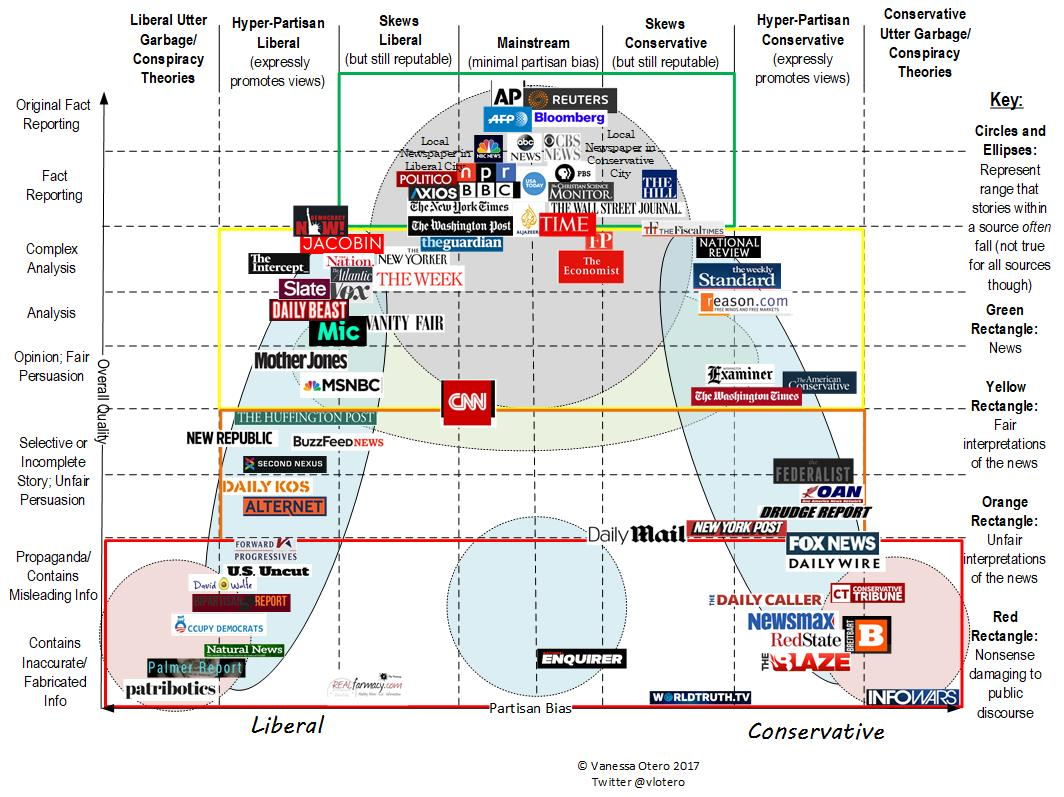
Since debunking fake news is so difficult, it is better to stop it from spreading in the first place. It is important to recognize that every media outlet has bias, but that doesn’t necessarily mean they aren’t presenting facts. Here is a chart of popular news outlets arranged by bias and also by how fact-based they are. Being a savvy news consumer is critical. Use reputable sources and always read the whole article before commenting or sharing. Verify the information presented by clicking on links to the source material to see if it supports the claims in the article. Also, verify the information in at least two other reputable sources. The more outrageous the claim, the more important it is to verify before spreading.


Being a savvy media consumer also means thinking about the purpose of the information being presented. One of the main purposes of provocative headlines is to be clickbait, because clicks are how money is made. You probably recognize headlines like “follow this one simple trick” as being advertisements. But fake news can be advertisements too. One teenager in Macedonia got rich off of people clicking on his completely fabricated news during the 2016 election.

How can you identify fake news? FactCheck.org offers the following advice:


  • Consider the source. Is it the real web address of a legitimate media outlet or something that looks similar? Is it a real newspaper (ex., The Boston Globe) or a fake newspaper (ex., The Boston Tribune)?

  • Is there a byline, and if so, is it a real person

  • Read the source material. Sometimes the studies, articles, databases, etc., being cited don’t support the claim being made at all.

  • Check the date. If an event occurred two years ago or more, then the current president can’t take credit for it.

  • Make sure it’s not satire. For example, The Borowitz Report is a satirical news column that people sometimes mistake for real news.


    Being a savvy media consumer is important, but few will make the effort. Shouldn’t the system be doing something about fake news? The 2018 election is almost here and there is little evidence that any safeguards have been put in place. We won’t get any help from Trump, of course, but Congress should make recommendations for meaningful changes when they complete their investigations. We need to hold Congress accountable.

    Social media organizations like Facebook and Google have pledged to do something about fake news, but they recently promoted hoaxes after the Las Vegas shooting, proving that they have a lot more work to do. Facebook has agreed to start labeling disputed articles, but won’t take them down. We need to hold social media companies accountable as well. As elections approach, we need to demand that our elected officials prevent further meddling. Stay tuned to TWW Louisville for actions you can take in 2018.


    For more info:

    Understanding Fake News

    Building a Fact-Based Reality: Understanding Fake News 

    Ellen Birkett Morris

    From completely fabricated stories to misunderstood satire, stories that look like news can be completely false. But fake news has real consequences. It can sway elections, ruin reputations and cause violence as it did when a man fired a rifle in a Washington, D.C. 
    pizza restaurant.


    How do you make sense of information in an environment where the president labels real news as “fake news” and Russian hackers and conspiracy theorists spread fake news on the internet that is designed to look real?

    Alexios Mantzarlis, director of the International Fact-Checking Network at Poynter, and Melissa Zimdars, an assistant professor of communication and media at Merrimack College in North Andover, Mass., offered tips to identify fake news. You can find the full article HERE

    Pay Attention to the Domain and URL

    Established news organizations usually own their domains and they have a standard look that you are probably familiar with. Sites with such endings like ".com.co" should make you raise your eyebrows and tip you off that you need to dig around more to see if they can be trusted. This is true even when the site looks professional and has semi-recognizable logos. For example, abcnews.com is a legitimate news source, but abcnews.com.co is not despite its similar appearance.

    Read the "About Us" Section

    Most sites will have a lot of information about the news outlet, the company that runs it, members of leadership, and the mission and ethics statement behind an organization. The language used here is straightforward. If it's melodramatic and seems overblown, you should be skeptical. Also, you should be able to find out more information about the organization's leaders in places other than that site.

    Look at the Quotes in a Story

    Or rather, look at the lack of quotes. Most publications have multiple sources in each story who are professionals and have expertise in the fields they talk about. If it's a serious or controversial issue, there are more likely to be quotes — and lots of them. Look for professors or other academics who can speak to the research they've done. And if they are talking about research, look up those studies.

    Look at Who Said Them

    Then see who said the quotes and what they said. Are they a reputable source with a title that you can verify through a quick Google search? Say you're looking at a story and it says President Obama said he wanted to take everyone's guns away. And then there's a quote. Obama is an official who has almost everything he says recorded and archived. There are transcripts for pretty much any address or speech he has given. Google those quotes. See what the speech was about, who he was addressing and when it happened. Even if he did an exclusive interview with a publication, that same quote will be referenced in other stories, saying he said it while talking to the original publication.

    Check the Comments

    A lot of these fake and misleading stories are shared on social media platforms. Headlines are meant to get the reader's attention, but they're also supposed to accurately reflect what the story is about. Lately that hasn't been the case. Headlines often will be written in exaggerated language with the intention of being misleading, and then attached to stories that are about a completely different topic or just not true. These stories usually generate a lot of comments on Facebook or Twitter. If a lot of these comments call out the article for being fake or misleading, it probably is.

    Reverse Image Search

    A picture should be accurate in illustrating what the story is about. This often doesn't happen. If people who write these fake news stories don't even leave their homes or interview anyone for the stories, it's unlikely they take their own pictures. Do a little detective work and reverse search for the image on Google. You can do this by right-clicking on the image and choosing to search Google for it. If the image is appearing on a lot of stories about many different topics, there's a good chance it's not actually an image of what it says it was on the first story.

    These tips are just a start at determining what type of news an article is. Zimdars outlined these and others in a guide for her students. If you take these steps, you're helping yourself and you're helping others by not increasing the circulation of these stories.

    And you won't be the only one trying to stop the spread of this false content. The company leaders behind the platforms these stories are shared on are trying to figure out how to fix the issue from their side, but they are also trying to make sure not to limit anyone's right to freedom of speech. It's a tricky position to be in, but they've said they'll try. 

    In the end, it really does depend on taking responsibility and being an engaged consumer of news.

    Satire Sites

    Here's one last thing. Satirical publications exist and serve a purpose, but are clearly labeled as exaggerated and humorous by the writers and owners. Some of the more well-known ones like The Onion and ClickHole use satire to talk about current events. If people don't understand that, they might take them seriously and then share these articles after reading them. If this happens or if you see your friends sharing blatantly fake news, be a friend and kindly tell them it's not real. Don't shy away from these conversations even if they might be uncomfortable. As I said earlier, everyone has to help fix the fake news problem.

    Here is another resource for finding fake news:

    If you want to take it step further try this game that helps sort out the real from the fake:
    Help take back our democracy and become an activist for the truth.


    Tuesday

    Sex Trafficking increases during large events.


    Sex Trafficking increases during large events.
    You might witness at a hotel, restaurant, rest area etc. 

    ADD this number to your phone. 
    888-373-7888

    The HOTLINE is the best number to call. 
    They know exactly what to do and exactly who to call anywhere in the US
    This is an ongoing issue in all communities.

    Please begin to think about what you would if you witnessed this situation. 
    The more you consider that - the more you will be prepared to help.


    Sunday

    Call For KY 2018

     by Naomi Penner


    ! Call List 4/23!
    LRC MESSAGE LINE: 1-800-372-7181
    Hours: M-Th 7am-9pm, F 7-5

    Tell Governor Bevin to VETO:
    + HB 169 (youth incarceration bill)
    + HB 274 (reduces request time for absentee ballot)
    + HB 302 (kills government transparency)

    + HB 97 (changes candidate filing deadline to 1st Friday in Jan. to last Tues. = less time)
    + HB 193 (HIV criminalization bill)

    Main office: 502-564-2611
    Email: Bryan.sunderland@ky.gov
    Text: "RESIST" to 50409 (Resistbot) to send a Fax
    Tweet: @GovMattBevin


    These calls MATTER - they turn into 'green slips' that your legislator can literally hold up to show 'your' support for an issue.


    Stay tuned! Make sure to follow along and share with the hashtag: #kyga18